

Laser hair reduction for Indian skin can be safe, effective, and long-lasting when the right laser technology is used with the right settings. The challenge is that Indian skin contains more melanin than lighter skin tones, so treatment must be planned carefully to reduce the risk of burns, pigmentation, and uneven results.
At Dermasure, laser hair reduction is approached as a medical treatment, not a salon service. The goal is to match your skin tone, hair type, hormonal profile, and treatment area with the safest possible laser settings for consistent hair reduction.
Why Indian Skin Needs a Different Laser Approach
Laser hair reduction works by targeting melanin in the hair follicle. The laser energy heats the follicle and gradually weakens its ability to produce new hair. This is why dark, coarse hair usually responds better than fine or light hair.
However, Indian skin also has a higher melanin content. If the wrong laser or incorrect settings are used, the laser may affect the surrounding skin instead of focusing only on the follicle. This can lead to irritation, burns, dark patches, or poor results.
That is why laser hair reduction for Indian skin should always be performed with medical-grade technology and proper skin assessment before treatment begins.
Best Lasers for Indian Skin
Not every laser is suitable for deeper skin tones. The safest and most effective options are usually Nd:YAG and diode lasers, when used by trained professionals.
Nd:YAG Laser
The Nd:YAG laser uses a 1064 nm wavelength, which goes deeper into the skin and avoids excessive heating of surface melanin. This makes it one of the preferred options for darker Indian skin tones, especially Fitzpatrick Type IV to VI skin.
It is useful for areas like the face, underarms, bikini line, legs, back, and chest when calibrated correctly.
Diode Laser
The 808 nm diode laser is also commonly used for Indian skin. It works well for medium to darker skin tones and is especially useful for larger areas like arms, legs, and back. Modern diode systems with cooling help make the treatment more comfortable and controlled.
Why IPL Should Be Avoided for Indian Skin
IPL is not a true laser. It uses broad-spectrum light, which is less precise than medical-grade laser technology. On Indian skin, especially deeper tones, IPL may increase the risk of burns, pigmentation, and inconsistent results.
Before booking treatment, always ask whether the clinic uses true laser technology or IPL. This one question can make a major difference to your safety and outcome.
How Many Sessions Are Needed for Laser Hair Reduction?
Most patients need around 6 to 8 sessions for visible and long-lasting reduction. Areas affected by hormones, such as the face, chin, jawline, and neck, may need 8 to 10 sessions or periodic maintenance.
Laser works only on hair follicles in the active growth phase. Since all follicles are not active at the same time, multiple sessions are required to target hair across different growth cycles.
After a full course, many patients notice a 70% to 90% reduction in hair growth. The remaining hair usually becomes finer, lighter, and slower to grow.
Areas That Respond Well to Laser Hair Reduction
Laser hair reduction can be performed on most body areas when the skin is assessed properly. Common treatment areas include:
- Upper lip, chin, sideburns, and full face
- Underarms
- Arms and legs
- Bikini and Brazilian area
- Back, shoulders, chest, and abdomen
Dark, coarse hair responds fastest. Fine facial hair and hormone-related growth usually need more sessions and better long-term planning.
What to Do Before Laser Hair Reduction
Preparation is important for safe results, especially on Indian skin. Four to six weeks before treatment, avoid waxing, threading, or plucking because these remove the hair root that the laser needs to target.
- Shaving is allowed and usually recommended before the session.
- Use SPF 50 daily, especially on exposed areas.
- Avoid tanning and direct sun exposure before treatment.
- Tell your doctor about PCOS, thyroid issues, pregnancy, medicines, or recent skin treatments.
What Happens During and After Treatment
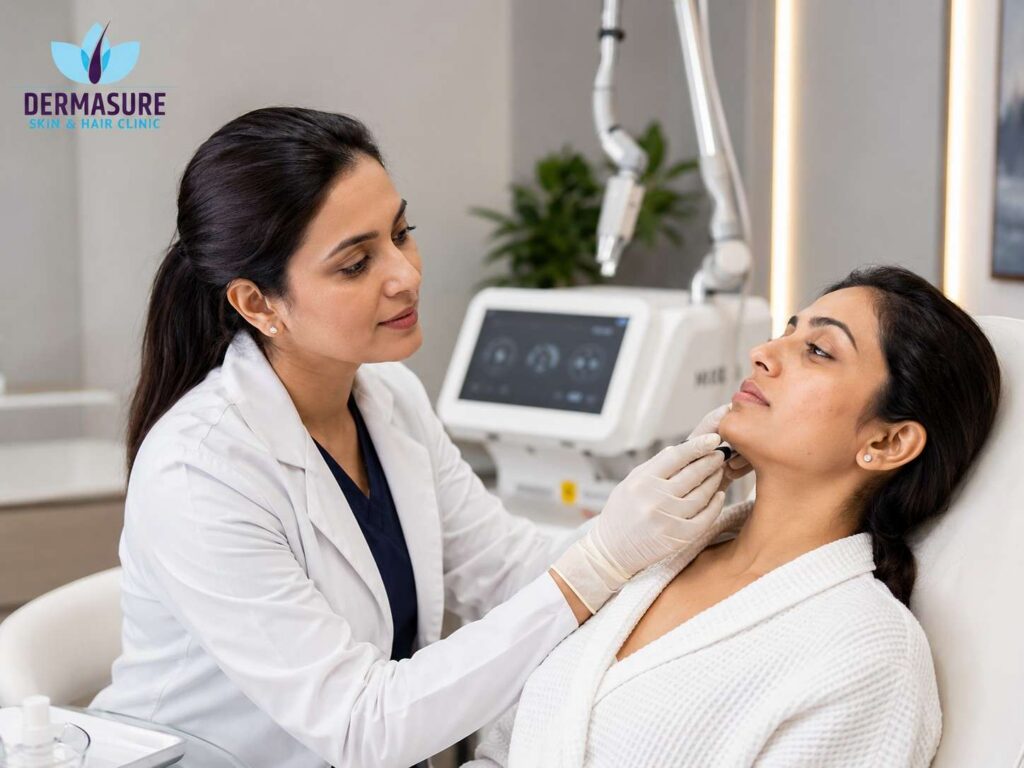
During the session, a cooling gel or cooling device may be used to protect the skin. Most patients describe the sensation as mild warmth or a quick rubber-band snap. Treatment time can range from 15 minutes for smaller areas to 45 minutes or more for larger areas.
After treatment, mild redness or warmth can occur and usually settles within a few hours. Hair does not fall out immediately. It sheds naturally over the next two to three weeks, which is a normal sign that the treatment is working.
Aftercare is simple but important. Avoid sun exposure for 48 to 72 hours, continue daily sunscreen, and do not wax or thread between sessions. Shaving between sessions is fine.
Common Mistakes to Avoid
- Choosing a clinic only because it offers the cheapest package
- Not asking which laser technology is being used
- Waxing or threading between sessions
- Stopping after 2 or 3 sessions and expecting final results
- Ignoring sunscreen after treatment
- Not informing the doctor about PCOS or hormonal hair growth
Is Laser Hair Reduction Permanent?
Laser hair reduction is best understood as permanent reduction, not complete permanent removal. After a full course, most patients experience a major and lasting reduction in hair growth. Some fine regrowth can happen later because of hormonal changes, PCOS, pregnancy, or menopause.
For long-term smoothness, an annual maintenance session may be recommended. Patients with PCOS or facial hair may need maintenance more frequently.
Why Choose Dermasure for Laser Hair Reduction?
Dermasure focuses on safe, doctor-led laser hair reduction for Indian skin tones. The treatment plan is based on your skin type, hair thickness, treatment area, and medical history instead of a standard package.
With the right technology, accurate settings, and proper aftercare, laser hair reduction can be one of the most effective long-term solutions for unwanted hair on Indian skin.
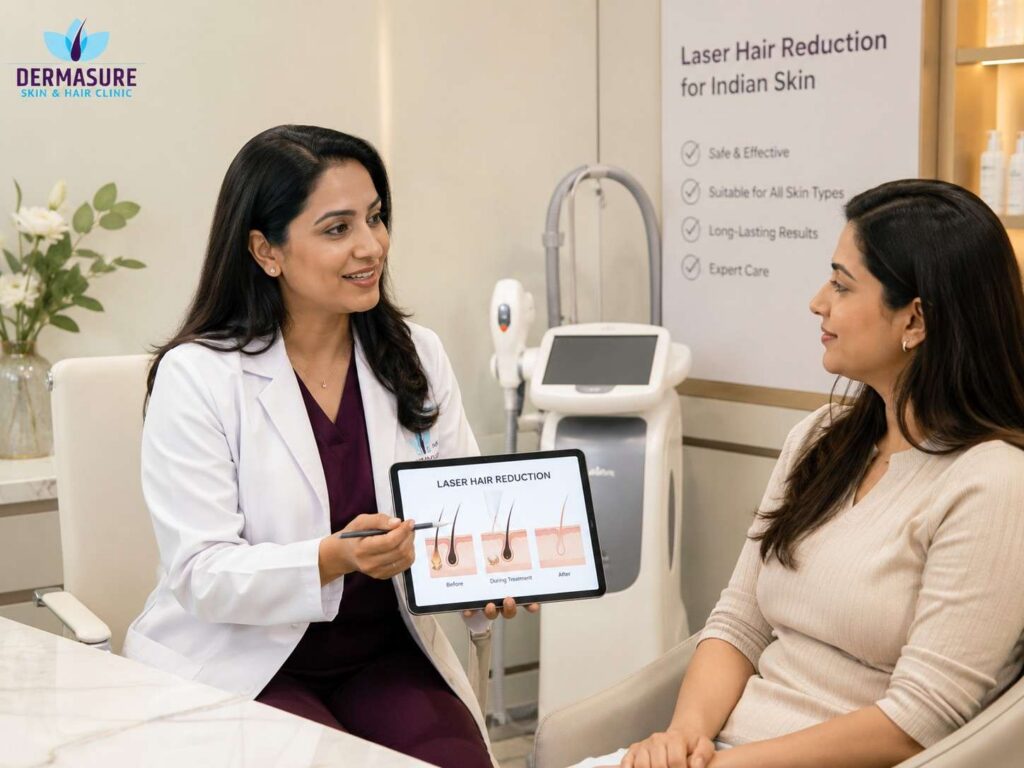
Book your laser hair reduction consultation at Dermasure and get a personalised plan for your skin and hair type.
FAQs
Can laser hair reduction be done on Indian skin?
Yes. Laser hair reduction is safe for Indian skin when the right laser, such as Nd:YAG or diode, is used with proper settings and medical supervision.
How many sessions are needed for Indian skin?
Most patients need 6 to 8 sessions. Hormonal areas like the face, chin, and jawline may need 8 to 10 sessions and occasional maintenance.
Does laser hair reduction hurt?
Most patients feel mild warmth or a quick snapping sensation. Modern systems with cooling make the treatment much more comfortable.
Can I do laser hair reduction if I have PCOS?
Yes. Laser can reduce PCOS-related hair growth, but you may need more sessions and maintenance. Hormonal management may also be advised for best results.
How soon will I see results?
Many patients notice visible reduction after 2 to 3 sessions. The full result is assessed after completing the recommended treatment course.